> [[tcj-soas-ics-02-a|← Previous]] | [[tcj-soas-ics-toc|TOC]] | [[tcj-soas-ics-02-c|Next →]]
# Chapter II. Les Buissonnets
## The Writing Timeline (What Was Happening as She Wrote it)
**Date Written:** 1895 (Part of Manuscript A).
**Thérèse's Age:** 22 years old.
**The Context:** She is drafting this manuscript in her Carmel cell out of strict obedience to her prioress, Mother Agnes of Jesus. Thérèse is writing about the profound, world-shattering grief of losing Pauline to the convent, while actively handing these very pages *to* Pauline inside that same convent. She is 22-years-old, experiencing a season of immense grace and stability, preparing for her offering to Merciful Love.

**Date:** between January 21 and March 25, 1895.
---
## The Event Timeline (What Was Happening then)
**Dates:** [[tcj-soas-chronology#1877 (age 4)|November 1877]] to [[tcj-soas-chronology#1878 (age 5)|1878]]
**Thérèse's Age:** 4 to 5 years old
**The Context:** Following the death of Madame Martin, the family moves from Alençon to Lisieux in November 1877 to be near Uncle Guérin They settle into Les Buissonnets. During these years, Thérèse struggles with a deep shift in her personality, becoming highly sensitive and quiet. The chapter traces her early childhood memories in this new home, her growing relationship with her sisters, and concludes with her seeing the sea for the very first time during a family trip to Trouville.
---
![[Thérèse-age-5.png|300]]
_Age 5 — reconstructed portrait_
---
# Chapter II. Les Buissonnets
(1877–1881)
Her Mother’s Death
Lisieux
Her Father’s Tenderness
First Confession
Feasts and Sundays with the Family
Prophetic Vision
Trouville
## Her Mother’s Death
All the details of my mother’s illness are still present to me and I recall especially the last weeks she spent on earth. Céline and I [-10-] were like two poor little exiles, for every morning Madame Leriche [[tcj-soas-ics-02-b#^tcj-fn-ch2-30|30]] came to get us and brought us to her home where we spent the day. One morning we didn’t have time to say our prayers and during the trip Céline whispered: “Should we tell her we didn’t say our prayers?” “Oh! yes,” I answered. So very timidly Céline told Madame Leriche, [-15-] who said: “Well, my little girls, you will say them,” and placing us both in a large room, she left. Céline looked at me and we said: “Oh! this is not like Mama! She always had us say our prayers with her.”
When we were playing with the children, the thought of our dear mother was with us constantly. Once Céline was given a beautiful apricot, and [-20-] she bent down and said to me: “We are not going to eat it; I will give it to Mama.” Alas, poor little Mother was already too sick to eat the fruits of the earth; she was _to be satisfied_ only in heaven with God’s _glory_ and was _to drink_ the mysterious wine He spoke about at the Last Supper, saying He would share it with us in His Father’s kingdom.[[tcj-soas-ics-02-b#^tcj-fn-ch2-31|31]] The touching ceremony of the last anointing is also deeply impressed on my mind. I can still see the spot where I was by Céline’s side. All five of us were [12v°] lined up according to age, and Papa was there too, sobbing.
The day of Mama’s departure or the day after, [[tcj-soas-ics-02-b#^tcj-fn-ch2-32|32]] Papa took me in his arms and said: “Come, kiss your poor little mother for the last time.” Without a word I placed my lips on her forehead. [-5-] I don’t recall having cried very much, neither did I speak to anyone about the feelings I experienced. I looked and listened in silence. No one had any time to pay any attention to me, and I saw many things they would have hidden from me. For instance, once I was standing before the lid of the coffin which had been placed upright in the hall.
I stopped for a long time gazing at it. [-10-] Though I’d never seen one before, I understood what it was. I was so little that in spite of Mama’s small stature, I had to raise my head to take in its full height. It appeared _large_ and _dismal_.
Fifteen years later, I was to stand before another coffin, Mother Geneviève’s.[[tcj-soas-ics-02-b#^tcj-fn-ch2-33|33]] It was similar in size. I imagined myself back once again in the [-15-] days of my childhood and all those memories flooded into my mind. True, it was the same Thérèse who looked, but she’d _grown up_ and the coffin appeared smaller. I had no need to _raise_ my head to see and, in fact, no longer _raised_ it but to contemplate _heaven_ which to me was _filled with joy_. All my trials had come to an end and the winter of my soul had passed on [-20-] forever.
The day the Church blessed the mortal remains of our dear mother, now in heaven, God willed to give me another mother on earth. He willed also that I choose her freely. All five of us were gathered together, looking at each other sadly. Louise was there too, and, seeing Céline and me, she said: “Poor little things, you have no mother any more!” Céline threw her arms around Marie saying:
“Well, you will be my Mama!” Accustomed to following [13r°] Céline’s example, I turned instead to you, Mother, and as though the future had torn aside its veil, I threw myself into your arms, crying:
“Well, as for me, it’s Pauline who will be my Mama!”
As I’ve already said, it’s from the end of this phase in my [-5-] life that I entered the second period of my existence, the most painful of the three, especially since the entrance into Carmel of the one whom I chose as my second “Mama.” This period extends from the age of four and a half to that of fourteen, the time when I found once again my _childhood_ character, and entered more and more into [-10-] the serious side of life.
I must admit, Mother, my happy disposition completely changed after Mama’s death. I, once so full of life, became timid and retiring, sensitive to an excessive degree. One look was enough to reduce me to tears, and the only [-15-] way I was content was to be left alone completely. I could not bear the company of strangers and found my joy only within the intimacy of the family.
And still I continued to be surrounded with the most delicate _tenderness_. Our father’s _very affectionate_ heart seemed to be enriched now with a [-20-] truly maternal love! You and Marie, Mother, were you not _the most tender_ and selfless of mothers? Ah! if God had not showered His beneficent _rays_ upon His little flower, she could never have accustomed herself to earth, for she was too weak to stand up against the rains and the storms. She needed warmth, a gentle dew, and the springtime breezes. Never were [13v°] these lacking. Jesus had her find them beneath the snow of trial!
I experienced no regret whatsoever at leaving Alençon; children are fond of change, and it was with pleasure that I came to Lisieux.
[[tcj-soas-ics-02-b#^tcj-fn-ch2-34|34]]
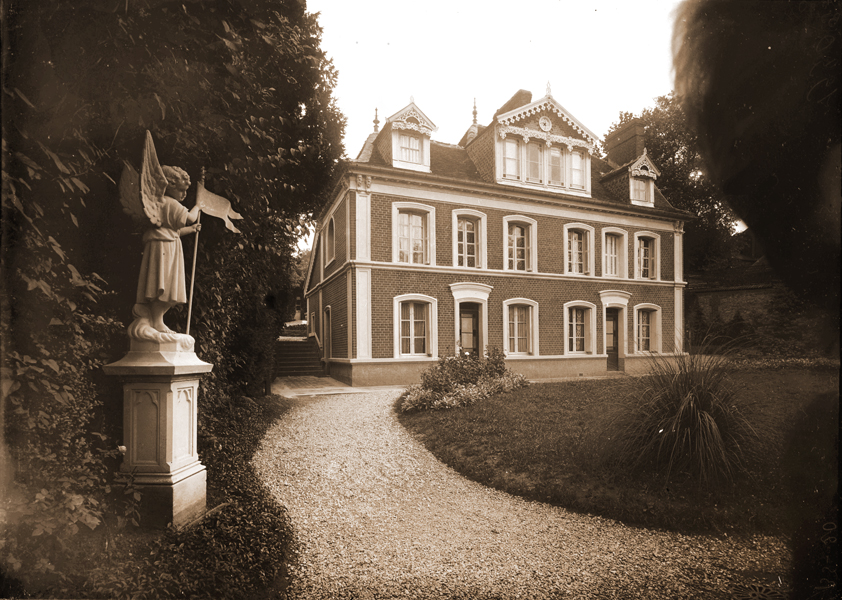
## Lisieux
---
I recall the trip, our arrival at Aunt’s home; and I can still picture [-5-] Jeanne and Marie waiting for us at the door. I was very fortunate in having such nice little cousins. I loved them very much, as also Aunt and especially Uncle; however, he frightened me, and I wasn’t as much at ease in his home as I was at Les Buissonnets, [[tcj-soas-ics-02-b#^tcj-fn-ch2-35|35]] for there my life was truly happy.In the morning you used to come to me and [-10-] ask me if I had raised my heart to God, and then you dressed me. While dressing me you spoke about Him and afterward we knelt down and said our prayers together. The reading lesson came later and the first word I was able to read without help was “heaven.” My dear godmother took charge of the writing lessons and you, Mother, all the rest. I enjoyed no great facility in learning, [-15-] but I did have a very good memory. Catechism and sacred history were my favorite subjects and these I studied with joy. Grammar frequently caused me to shed many tears. You no doubt recall the trouble I had with the masculine and feminine genders!
## Her Father’s Tenderness
As soon as my classes were over, I climbed up to the belvédère [[tcj-soas-ics-02-b#^tcj-fn-ch2-36|36]] and showed my badge and my marks to Papa. How happy I was when I could [-20-] say: “I _got full marks_, and it’s _Pauline_ who said so _first!_” For when I asked you if I had five full marks and until you said “Yes,” the marks seemed lower in my own eyes. You gave me points for good conduct and when I collected a certain number I got a prize and a free day. I recall these free days [14r°] seemed longer than the others; this pleased you as it was a sign I didn’t like being idle. Each afternoon I took a walk with Papa. We made our visit to the Blessed Sacrament together, [-5-] going to a different church each day, and it was in this way we entered the Carmelite chapel for the first time. Papa showed me the choir grille and told me there were nuns behind it. I was far from thinking at that time that nine years later I would be in their midst!
After the walk (during which Papa bought me a little [-10-] present worth a few sous we returned to the house; then I did my homework and the rest of the time I stayed in the garden with Papa, jumping around, etc., for I _didn’t know_ how to play with dolls. It was a great joy for me to prepare mixtures with little seeds and pieces of bark I found on the ground, and I’d bring them to Papa [-15-] in a pretty little cup. Poor Papa stopped all his work and with a smile he pretended to drink. Before giving me back the cup he’d ask me (on the sly) if he should throw the contents out. Sometimes I would say “Yes,” but more frequently I carried away my precious mixture, wanting to use it several times.
I loved cultivating my little flowers [-20-] in the garden Papa gave me. I amused myself, too, by setting up little altars in a niche in the middle of the wall. When I completed my work, I ran to Papa and dragged him over, telling him to close his eyes and not open them till I told him. He did all I asked him to do and allowed himself to be led in front of my little garden, then I’d cry out: “Papa, open your eyes!” He would open them [14v°] and then go into an ecstasy to please me, admiring what I believed was really a masterpiece! I would never come to an end if I really wanted to portray a thousand little actions like this which crowd into my memory. How could I possibly express the tenderness which “_Papa_” showered upon his [-5-] little queen? There are things the heart feels but which the tongue and even the mind cannot express.
They were beautiful days for me, those days when my “dear king” took me fishing with him. I was very fond of the countryside, flowers, birds, etc. Sometimes I would try to fish with my little line, but I preferred to go _alone_ and [-10-] sit down on the grass bedecked with flowers, and then my thoughts became very profound indeed!
Without knowing what it was to meditate, my soul was absorbed in real prayer. I listened to distant sounds, the murmuring of the wind, etc. At times, the indistinct notes of some military music reached me where I was, filling my heart with a sweet melancholy. Earth then seemed to be a place of exile and I could dream only of [-15-] heaven.
The afternoon sped by quickly and soon we had to return to Les Buissonnets. Before leaving, I would take the lunch I had brought in my little basket. The _beautiful_ bread and jam you had prepared had changed its appearance: instead of the lively colors it had earlier, I now saw only a light rosy tint and the bread had become old andcrumbled. [-20-] Earth again seemed a sad place and I understood that in heaven alone joy will be without any clouds.
Speaking of clouds, I remember one day when the beautiful blue sky became suddenly overcast and soon the thunder began to roll and the lightning to flash through the dark clouds. I saw it strike a short distance away, and, far from being frightened, I was thrilled with delight because God [15r°] seemed to be so close! Papa, however, was not as delighted as his little queen. It wasn’t because the storm frightened him but because the grass and the tall daisies (taller than I) were beginning to sparkle with precious stones. We had to cross several fields before coming to [-5-] a road, and Papa, fearing the diamonds would soak his little girl, picked her up and carried her on his back in spite of his bundle of lines.
During the walks I took with Papa, he loved to have me bring alms to the poor we met on the way. On one occasion we [-10-] met a poor man who was dragging himself along painfully on crutches. I went up to give him a coin. He looked at me with a sad smile and refused my offering since he felt he wasn’t poor enough to accept alms. I cannot express the feeling that went through my heart. I wanted to console this man and [-15-] instead I had given him pain or so I thought. The poor invalid undoubtedly guessed at what was passing through my mind, for I saw him turn around and smile at me. Papa had just bought me a little cake, and I had an intense desire to give it to him, but I didn’t dare. However, I really wanted to give him something he couldn’t refuse, so great was the sympathy I felt toward him. I [-20-] remembered having heard that on our First Communion day we can obtain whatever we ask for, and this thought greatly consoled me. Although I was only six years old at this time, I said: “I’ll pray for this poor man the day of my First Communion.” I kept my promise five years later, and I hope God answered the prayer He inspired me to direct to Him in favor of one of His suffering members.
[15v°] I loved God very much and offered my heart to Him very often, making use of the little formula Mother had taught me. However, one evening in the beautiful month of May I committed a fault that merits the penalty of being confessed. It gave me [-5-] good reason to humble myself and I believe I had perfect contrition for it.
Since I was too little to attend May devotions, I remained at home with Victoire, [[tcj-soas-ics-02-b#^tcj-fn-ch2-37|37]] carrying out my devotions with her before _my little_ _May altar_. This I had arranged according to my taste; everything was so small, the candlestick, the flower pots, etc. _Two tapers_ lit it up perfectly. Sometimes Victoire [-10-] would surprise me with a gift of two candle stubs. But this was rare. All was in readiness one evening for us to commence our prayers, so I said to her: “Victoire, will you begin the Memorare? I’m going to light the tapers.” She pretended to begin but said nothing and looked at me, laughing. I watched my _precious tapers_ burning away rapidly and [-15-] begged her to recite the prayer, but she still said nothing. Then rising from my knees, I shouted at her and told her she was very wicked. Laying aside my customary gentleness, I stamped my foot with all my might. Poor Victoire stopped laughing. She looked at me in amazement and then showed me the two candle stubs she’d brought along. [-20-] After shedding tears of anger, I poured out tears of repentance, having a firm purpose of not doing it again!
Another time there was another incident with Victoire, but this time I had no repentance because I had kept calm. I wanted an ink stand that was on the shelf of the fireplace in the kitchen; being too little to take it down, I very _nicely_ asked Victoire to **[16r°]** give it to me, but she refused, telling me to get up on a chair. I took a chair without saying a word but thinking she wasn’t too nice; wanting to make her feel it, I searched out in my little head what offended me the most. She often called me [-5-] “a little brat” when she was annoyed at me and this humbled me very much. So _before jumping off_ my chair, I turned around with _dignity_ and said: “Victoire, you are a brat!” Then I made my escape, leaving her to meditate on the profound statement I had just made. The result wasn’t long in coming, for soon I heard her shouting: “M’amz’elle Marie Thérèse just [-10-] called me a brat!” Marie came and made me ask pardon, and I did so without having contrition. I thought that if Victoire didn’t want to stretch her _big arm_ to do me a _little service_, she merited the title _brat_.
And still Victoire was very fond of me and I was also fond of her. One day, she drew me out of a _great peril_ into which I had [-15-] tumbled through my own fault. She was ironing the clothes and she had at her side a bucket filled with water. I was watching her and at the same time swinging on a chair, which was a habit of mine. All of a sudden, the chair slipped from under me and I fell, not on the floor, but into the bucket! My feet met my head and I filled the bucket like a little [-20-] chick fills an eggshell! Poor Victoire gaped at me with great surprise, having never seen anything like it in her life. I wanted to extricate myself from my bucket as quickly as possible, but impossible! My prison fit me so perfectly I couldn’t make a single move. With a little trouble she saved me from my _great peril_ but not my dress and all the rest of my clothes which she had to change. I was soaked to the skin!
## First Confession
Another time I fell into the fireplace where fortunately there was no fire **[16v°]** lighted at the time. Victoire had to draw me out and shake off the ashes that covered me completely. These incidents happened to me on a Wednesday when you were at singing practice with Marie. It was on Wednesday also that Father Ducellier[[tcj-soas-ics-02-b#^tcj-fn-ch2-38|38]] came to pay a visit. Victoire [-5-] told him nobody was home except Thérèse, and so he came out into the _kitchen_ to see me and look over my homework; I was very proud to receive my _confessor_, for I had made my first confession to him a short time before. What a sweet memory for me!Oh! dear Mother, with what care you prepared me for my first confession, [-10-] telling me it was not to a man but to God I was about to tell my sins; I was very much convinced of this truth. I made my confession in a great spirit of faith, even asking you if I had to tell
Father Ducellier I loved him with all my heart as it was to God in person I was speaking. [-15-] Well instructed in all I had to say and do, I entered the confessional and knelt down. On opening the grating Father Ducellier saw no one. I was so little my head was below the arm-rest.
He told me to stand up. Obeying instantly, I stood and faced him directly in order to [-20-] see him perfectly, and I made my confession like a _big girl_ and received his blessing with _great devotion_ for you had told me that at the moment he gave me absolution the _tears of_ _Jesus_ were going to purify my soul. I remember the first exhortation directed to me. Father encouraged me to be devout to the Blessed Virgin and I promised myself to redouble my tenderness for her.
[[tcj-soas-ics-02-b#^tcj-fn-ch2-39|39]]
Coming out of the confessional I was so happy and light-hearted that I had never felt so much joy in my **[17r°]** soul. Since then I’ve gone to confession on all the great feasts, and it was truly a _feast_ for me each time.
## Feasts and Sundays with the Family
The _feasts!_ what memories this word brings back to me. How I loved the _feasts!_ You knew how to explain all the mysteries [-5-] hidden under each, and you did it so well that they were truly heavenly days for me. I loved above all the processions in honor of the Blessed Sacrament. What a joy it was for me to throw flowers beneath the feet of God! Before allowing them to fall to the ground, I threw them as high as I could and I was never so happy as when I saw my roses _touch_ the sacred monstrance. [-10-] If the big feasts were rare, each week brought one that was very dear to my heart, namely Sunday! What a day Sunday was for me! It was God’s feast day, and feast of _rest_. First, I stayed in _bed_ longer than on the other days; then Pauline spoiled her little girl bybringing her some chocolate to drink while still in _bed_ and then she [-15-] dressed her up like a little queen. Marie came to curl her hair and
Thérèse was not always nice when Marie pulled her hair. Afterward she was very happy to take the hand of her _king_ who on that day kissed her more tenderly than usual. The whole family then went off to Mass.
All along the way to church and even in the church [-20-] Papa’s little queen held his hand. Her place was by his side, and when we had to go down into the body of the church to listen to the sermon, two chairs had to be found side by side. This wasn’t too difficult, for everyone seemed to think it so wonderful to see such a _handsome_ old man with such a _little daughter_ that they went out of their way to give them their places. Uncle, sitting in the warden’s pews, was always happy to see us come. He used to call me his little **[17v°]** ray of sunshine. I wasn’t too disturbed at being looked at by people. I listened attentively to the sermons which I understood very poorly. The first I _did understand_ and which _touched me deeply_ was a sermon on the Passion preached by Father Ducellier and since then I’ve [-5-] understood all the others. When the preacher spoke about St. Teresa, Papa leaned over and whispered: “Listen carefully, little queen, he’s talking about your Patroness.” I did listen carefully, but I looked more frequently at Papa than at the preacher, for his _handsome_ face said so much to me! His eyes, at times, were filled with _tears_ which he tried in vain to [-10-] stop; he seemed no longer held by earth, so much did his soul love to lose itself in the eternal truths. His earthly course, however, was far from completed; long years had to pass by before heaven opened to his enraptured eyes and the Lord would wipe the _tears_ from the eyes of His good and faithful servant! [-15-] I return once more to my Sundays. This _joyous_ day, passing all too quickly, had its tinge of _melancholy_. I remember how my happiness was unmixed until Compline.[[tcj-soas-ics-02-b#^tcj-fn-ch2-40|40]] During this prayer, Iwould begin thinking that the day of _rest_ was coming to an end, that the morrow would bring with it the necessity of beginning life over again, we would have to go back [-20-] to work, to learning lessons, etc., and my heart felt the exile of this earth. I longed for the everlasting repose of heaven, that never-ending _Sunday_ of the _fatherland!_
The walks we took on Sundays before returning to Les Buissonnets left a feeling of sadness in my soul, for then the family was not complete. Papa, to please Uncle, used to permit Marie or Pauline to spend Sunday evenings at his home; [18r°] I was happy when I was there with one of them. I preferred this to being invited all alone because then they paid less attention to me. I listened with great pleasure to all Uncle had to say, but I didn’t like it when he asked me questions. I was very much [-5-] frightened when he placed me on his knee and sang Blue Beard in a formidable tone of voice. I was happy to see Papa coming to fetch us. When we were on the way home, I would gaze upon the _stars_ that were twinkling ever so peacefully in the skies and the sight carried me away. There was especially one cluster of _golden pearls_ that attracted my attention and gave me great joy [-10-] because they were in the form of a –T–. I pointed them out to Papa and told him my name was written in heaven. Then desiring to look no longer upon this dull earth, I asked him to guide my steps; and not looking where I placed my feet I threw back my head, giving myself over completely [-15-] to the contemplation of the star-studded firmament!
What shall I say of the winter evenings at home, especially the Sunday evenings? Ah! how I loved, after the _game of checkers_ was over, to sit with Céline on Papa’s knees.[[tcj-soas-ics-02-b#^tcj-fn-ch2-41|41]] He used to sing, in his beautiful voice, airs that filled the soul with profound thoughts, or else, [-20-] rocking us gently, he recited poems that taught the eternal truths. Then we all went upstairs to say our night prayers together and the little queen was alone near her king, having only to look at him to see how the saints pray. When prayer was ended we came according to age to bid Papa good night and receive his kiss; the _queen_ naturally came last and the _king_ **[18v°]** took her by the two _elbows_ to kiss her and she would cry out in a high-pitched tone: “Good night, Papa, good night and sleep well!” Every evening was a repetition of the same thing.
Then my little Mama took me in her arms and brought me to Céline’s bed. I would say: “Was I very [-5-] good today, Pauline? Will the _little angels fly around me?_” The answer was invariably “Yes,” otherwise I would have cried the whole night. After she and Marie had kissed me, _Pauline_ went downstairs and poor little Thérèse was left all alone in the dark; in vain did she [-10-] picture the _little angels_ _flying around her_; fright soon took over, the darkness filled her with fear, for she could no longer see the stars twinkling away serenely.
I consider the overcoming of my fears as a grace I received through you, dear Mother; you used to send me [-15-] in the evening to a far-off room in search of an object. Had I not been so well guided, I would have been very nervous, whereas now it is difficult to frighten me. I wonder at times how you were able to raise me with so much _love_ and tenderness without spoiling me, for it’s true you never allowed an [-20-] imperfection to pass, you _never_ scolded me without a reason, and you never went back on something once you made a decision. I knew this so well, I wouldn’t have been able nor would I have wanted to do anything you had forbidden. Papa himself was obliged to conform to your will, for without _Pauline’s_ consent I didn’t even take a walk, and when Papa told me to come
I’d answer: “_Pauline_ doesn’t want it.” **[19r°] ** Then he’d come and ask your permission and to please him, Pauline would say “Yes,” but little Thérèse saw by her look that she wasn’t saying it with all her heart, and she’d begin to cry and would not be consoled until Pauline said “Yes” and _kissed her with all her heart!_ [-5-] When little Thérèse was sick, which happened every winter,
[[tcj-soas-ics-02-b#^tcj-fn-ch2-42|42]] it isn’t possible to explain the maternal tenderness she received.Pauline then made her sleep in her bed (incomparable favor) and gave her everything she wanted. One day Pauline drew a _beautiful_ _little knife_ from under her pillow and giving it to her little girl [-10-] left her in an indescribable ecstasy. “Ah! Pauline,” she cried, “you love me so much you’re willing to deprive yourself of your little knife with the _mother of pearl star!_ Since you love me so much, would you sacrifice your _watch_ to prevent me from _dying?_” _—_“I would give you [-15-] my watch not only to prevent you from dying, but to see you get well soon I’d sacrifice it immediately.” When I heard Pauline’s words, my astonishment and gratitude were so great I couldn’t express them. In the summer, I had stomach aches at times, and
Pauline again took tender care of me. To amuse me she [-20-] _would drive_ me all around the garden in a _wheelbarrow_ and then, making me get off, she’d put in a little daisy plant and _drive_ this _very carefully_ to my little garden where she’d plant it with great ceremony.
It was Pauline, too, who received all my intimate confidences and cleared up all my doubts. Once I was surprised that God didn’t **[19v°]** give equal glory to all the elect in heaven, and I was afraid all would not be perfectly happy. Then Pauline told me to fetch Papa’s large tumbler and set it alongside my thimble and filled both to the brim with water. She asked me which one was fuller. I told her [-5-] each was as full as the other and that it was impossible to put in more water than they could contain. My dear mother helped me understand that in heaven God will grant His elect as much glory as they can take, the last having nothing to envy in the first. And it was in this way that you brought the most sublime mysteries down to my level of understanding and [-10-] were able to give my soul the nourishment it needed.
How glad I was to see the day of the distribution of prizes arrive each year! In this as in all other _matters_, _justice_ was strictly observed and I received only the rewards I deserved. All alone, standing before the _august assembly_, I listened to my sentence being read by“the king of France and Navarre”; my heart [-15-] was beating rapidly as I received my prizes and the crown. It was like a picture of the Last Judgment! Immediately after the distribution, the little queen took off her white dress and they quickly dressed her in disguise in order to take part in the _grand pageant_ that followed.
Ah! how joyous were these family feasts! How far I was [-20-] then from foreseeing the trials awaiting my dear king when seeing him so happy! One day, however, God showed me in a truly extraordinary _vision_ the _living_ image of the trial He was pleased to prepare for us in advance.[[tcj-soas-ics-02-b#^tcj-fn-ch2-43|43]]
Papa was on a trip for several days and was not expected to return for **[20r°]** two more days. It could have been about two or three o’ clock in the afternoon; the sun was shining brightly and all nature seemed to be rejoicing. I was all alone at the window of an attic which faced the large garden; I was looking straight ahead, my mind occupied with joyful thoughts, when I saw a man dressed exactly like Papa standing in front of [-5-] the laundry which was just opposite.
The man had the same height and walk as Papa, only he was _much_ _more stooped_. His head was covered with a sort of apron of indistinct color and it hid his face. He wore a hat similar to Papa’s. I saw him walking at a regular pace along [-10-] my little garden. Immediately a feeling of supernatural fright invaded my soul, but in an instant I reflected that surely Papa had returned and was hiding to surprise me; then I called out very loudly—“Papa! Papa!”—my voice trembling with emotion. But the mysterious personage, appearing not to hear, continued his steady pace without [-15-] even turning around. Following him with my eyes, I saw him go toward the grove that divides the wide path in two, and I waited to see him reappear on the other side of the tall trees, but the prophetic vision had vanished! All this lasted but an instant but was engraved so deeply on my heart that today, after fifteen years, it is as present to me as though I were still seeing the vision [-20-] before my eyes.Marie was with you, Mother, in a room adjoining the one where I was; hearing me call Papa, she experienced fright also, feeling, as she told me later, that something extraordinary must have happened.
Without allowing me to see her emotion, she ran to me and asked what possessed me to call Papa, who was still at Alençon. I **[20v°]** told her what I had just seen. To calm me down, Marie said it was no doubt Victoire who hid her head in her apron to frighten me, but when asked about it, Victoire said she hadn’t left her kitchen.
Besides, I was very sure I’d seen a man and this man [-5-] had Papa’s appearance. Then all three of us went behind the screen of trees, but when we found no mark indicating the passage of anyone, you told me to think no more about it.
It was not within my power to think no more about it. Very often my imagination presented again the mysterious scene I had witnessed. Very often, too, [-10-] I tried to lift the veil that was hiding its meaning from me because I kept in the bottom of my heart the conviction that this vision had a meaning which was one day to be revealed to me. That day was a long time in coming; but after fourteen years God Himself tore away the mysterious veil.
I had permission to be with Sister Marie of the Sacred Heart,[[tcj-soas-ics-02-b#^tcj-fn-ch2-44|44]] and we were talking as [-15-] always about the things of the other life and our childhood memories. I recalled to her the vision I had seen at the age of six or seven, and all of a sudden, while I was describing the details of the strange scene, we understood simultaneously what it meant. It was indeed _Papa_ whom I had seen advancing, bent over with age. It was indeed Papa, who was bearing on his venerable countenance and [-20-] white hair the symbol of his _glorious_ trial.[[tcj-soas-ics-02-b#^tcj-fn-ch2-45|45]] Just as the adorable Face of Jesus was veiled during His Passion, so the face of His faithful servant had to be veiled in the days of his sufferings in order that it might shine in the heavenly fatherland near its Lord, the Eternal Word!It is from the midst of this ineffable glory where he reigns in heaven that our dear father obtained for us the grace to understand the vision **[21r°]** his little queen had at an age when illusions are not to be feared. It is from the midst of glory he obtained this sweet consolation of understanding that God, ten years before our great trial, was already showing it to us. He was doing this as a Father who gives His children a glimpse of the [-5-] glorious future He is preparing for them and is pleased to have them consider in advance the priceless riches which will be their heritage.
Ah! why was it to me that God gave this light? Why did He show such a small child a thing she couldn’t understand, a thing which, if she had understood, would have [-10-] made her die of grief? Why?
This is one of the mysteries we shall understand only in heaven and which we shall eternally admire!
How good God really is! How He parcels out trials only according to the strength He gives us. Never, as I’ve said already, [-15-] would I have been able to bear even the thought of the bitter pains the future held in store for me. I wasn’t even able to think of Papa _dying_ without trembling. Once he had climbed to the top of a ladder and as I was standing directly below, he cried out: “Move away, little one, if I fall, I’ll crush you!” When I heard this, [-20-] I experienced an interior revulsion and instead of moving away I clung to the ladder, thinking: “At least, if Papa falls, I’ll not have the grief of seeing him die; I’ll die with him!”
I cannot say how much I loved Papa; everything in him caused me to admire him. When he explained his ideas to me (as though I were a big girl), I told him very simply that surely if he said this **[21v°]** to the great men of the government, they would take him to make him _king_, and then France would be happy as it had never been before.
But in the bottom of my heart I was happy that it was only myself who [-5-] _knew_ Papa _well_, for if he became _king of France and Navarre_, Iknew he would be unhappy because this is the lot of all monarchs; but above all he would no longer be my king alone!
I was six or seven years old when Papa brought us to Trouville.
[[tcj-soas-ics-02-b#^tcj-fn-ch2-46|46]]
Never will I [-10-] forget the impression the sea made upon me; I couldn’t take my eyes off it since its majesty, the roaring of its waves, everything spoke to my soul of God’s grandeur and power. I recall during the walk on the seashore a man and a woman were looking at me as I ran [-15-] ahead of Papa. They came and asked him if I were his little daughter and said I was a very pretty little girl. Papa said,
“Yes,” but I noticed the sign he made to them not to pay me any compliments. It was the first time I’d heard it said I was pretty and this pleased me as I didn’t think I was. You always [-20-] took great care, Mother, to allow me to come in contact with nothing that could destroy my innocence, and you saw to it, too, that I heard nothing capable of giving rise to vanity in my heart. As I listened to what you and Marie said, and as you had never directed any compliments to me, I gave no great importance to the words or admiring glances of this woman.
Was blessed **[22r°]** Wait, he bless them by having you moveIn the evening at that moment when the sun seems to bathe itself in the immensity of the waves, leaving a _luminous trail_ behind, I went and sat down on the huge rock with _Pauline_. Then I recalled the touching story of the “Golden Trail.”[[tcj-soas-ics-02-b#^tcj-fn-ch2-47|47]] I contemplated [-5-] this luminous trail for a long time. It was to me the image of God’s grace shedding its light across the path the little white-sailed vessel had to travel. And near Pauline, I made the resolution never to wander far away from the glance of Jesus in order to travel peacefully toward the eternal shore!
My life passed by tranquilly and happily. The affection with which I was [-10-] surrounded at Les Buissonnets helped me grow. I was undoubtedly big enough now to commence the struggle, to commence knowing the world and the miseries with which it was filled.
---
## Footnotes
## Chapter 2
30\. “Our cousin through her marriage with Monsieur Leriche, nephew of our father; he took over Father’s jewelry shop on Rue Pont-Neuf, Alençon, 1870” (Note of Mother Agnes of Jesus). ^tcj-fn-ch2-30
31\. [[matthew-26#^matthew-26-29|Mt 26:29]]\. ^tcj-fn-ch2-31
32\. Madame Martin died at 1:00 a.m., August 28, 1877\. ^tcj-fn-ch2-32
33\. Mother Geneviève of St. Teresa, one of the foundresses of the Lisieux Carmel. ^tcj-fn-ch2-33
34\. On November 15, 1877, Monsieur Martin decided to live at Lisieux in order to bring his daughters in closer contact with his wife’s family. Monsieur and Madame Guérin had two children: Jeanne, who was nine, and Marie, seven. Monsieur Guérin owned a pharmacy at Place St. Pierre. ^tcj-fn-ch2-34
35\. _Histoire d’une Ame_ states: “The next day, November 16, we were brought to our new home, Les Buissonnets, which was situated in a quiet section next to a park named ‘Jardin de l’Étoile.’ The house appeared very charming to me: a belvédère from which a view extended far into the distance, an English garden in front, and a large vegetable garden in the rear of the house, all this was a new joy to my young imagination. In fact, this smiling habitation became the theatre of many sweet joys and unforgettable family scenes. Elsewhere, as I said above, I was an exile, I wept, I felt I no longer had a mother! There, my heart expanded and I smiled once more at life.” ^tcj-fn-ch2-35
36\. The belvédère was the little summer room on the top floor where Monsieur Martin used to study. ^tcj-fn-ch2-36
37\. Victoire Pasquier was a servant of the Martin family at Lisieux. ^tcj-fn-ch2-37
38\. Priest at the Cathedral of Saint-Pierre at Lisieux. ^tcj-fn-ch2-38
39\. “I then passed my rosary through to have him bless it. It was evening and on the way home when we passed under a street light I looked at it from all sides. ‘What are you looking at, Thérèse?’ you asked. ‘I want to see what a blessed rosary looks like.’ This amused you. I remained a long time affected by the grace I received” (_Histoire d’une_ _Ame_). ^tcj-fn-ch2-39
40\. The liturgical night prayer of the Church. ^tcj-fn-ch2-40
41\. Marie or Pauline read from Dom Guéranger’s _Liturgical Year_; then a few pages of an interesting and instructive book. ^tcj-fn-ch2-41
42\. “The colds turned into bronchitis, but later this was cured completely. At Carmel she hardly ever had colds” (note of Mother Agnes of Jesus). ^tcj-fn-ch2-42
43\. This vision took place in broad daylight, not in a dream; it occurred in the summer of 1879 or 1880\. He was on business trip at Alençon. ^tcj-fn-ch2-43
44\. According to a custom then in usage in Carmel, the sisters had “permission” on certain feast days to converse privately with one another. ^tcj-fn-ch2-44
45\. The paralysis that affected Monsieur Martin’s mental faculties during the five last years of his life and necessitated a stay in the psychiatric hospital. See chapter 7 for more details. ^tcj-fn-ch2-45
46\. August 8, 1878; Thérèse was only five years and eight months old. ^tcj-fn-ch2-46
47\. This story appears in a collection of readings called _La Tirelire aux histoires_ by Madame Louise Belloc. This meditation, though, didn’t take place on August 8, 1878, but on another occasion sometime between 1879 and 1881\. ^tcj-fn-ch2-47
---
**Source:** [[whimsical-bibliography#^wbiblio-tcj-soas-ics|Thérèse, *Story of a Soul*]]
> [[tcj-soas-ics-02-a|← Previous]] | [[tcj-soas-ics-toc|TOC]] | [[tcj-soas-ics-02-c|Next →]]