> [[soas-chapter-2-les-buissonnets|Next →]]
# The Writing Timeline (What Was Happening as She Wrote it)
* **Date Written:** Early 1895 (The beginning of Manuscript A).
* **Thérèse's Age:** 22 years old.
* **The Context:** Thérèse is writing these memories out of strict obedience to the prioress, Mother Agnes of Jesus—who is none other than [Pauline](https://archives.carmeldelisieux.fr/en/personnage/mere-agnes-de-jesus), the sister she chose as her "second mother" back in Chapter I. While she is writing about the loss of her earthly mother and the subsequent shrinking of her childhood personality, she herself is experiencing a period of intense spiritual expansion and grace in Carmel, which will culminate in her offering to Merciful Love later that summer.
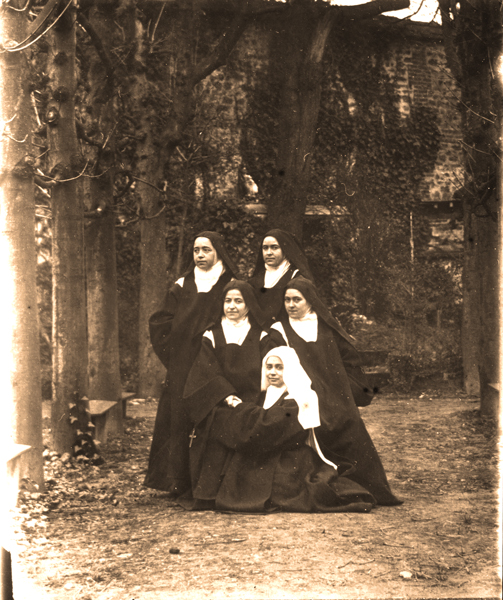
**Date:** 1895.
---
# The Event Timeline (What Was Happening then)
* **Dates:** January 1873 to late 1877.
* **Thérèse's Age:** Birth to 4 years old.
* **The Context:** Chapter I covers her deeply loved early childhood in Alençon. It is a time of immense security that is shattered by the traumatic death of her mother in August 1877. The day after the burial, Thérèse chooses her sister Pauline as her second mother.
---
# 1873 (newborn)
January 2: _Birth of Marie-Françoise-Thérèse Martin, 36 Saint Blaise Street, Alençon._
January 4: Baptism in the church of Notre-Dame; godmother: her sister, Marie.
March 15 or 16: sent out to be nursed to Rose Taillé, at Semallé (Orne).
---
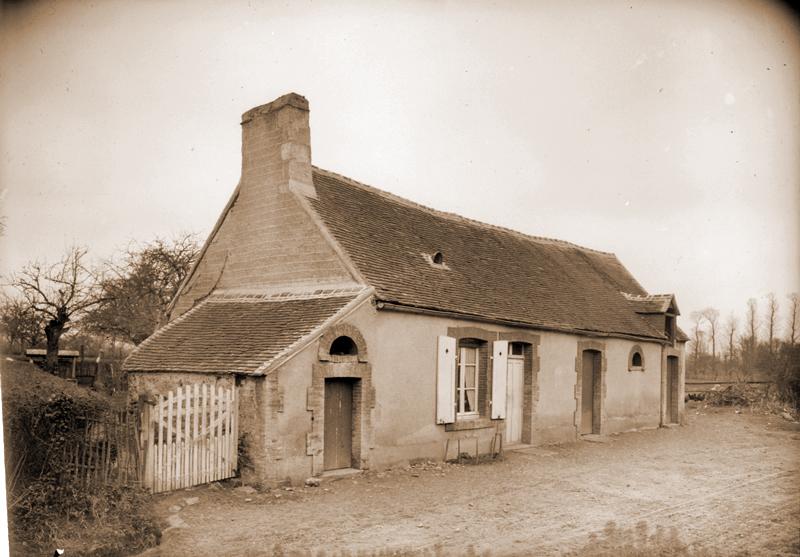
**Taillés.** This is where her nurse lived, [Rose Trimmed](https://archives.carmeldelisieux.fr/en/personnage/taille-rose-madame/), who had saved her thanks to her milk in March 1873 when she was 2 months old. Thérèse stayed with the Taillés until April 2, 1874.
---
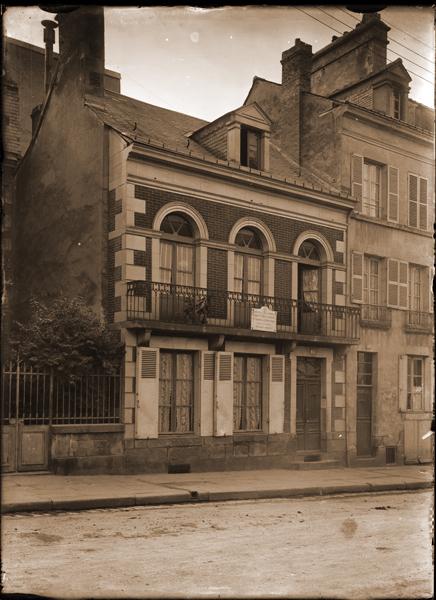
**Alençon** This house was then the scene of the family life of the Martins from 1871 to 1877. This is where Saint Thérèse was born on January 2, 1873. She lived there with her parents and sisters until the death of her mother. Zélie Martin on August 28, 1877 when Thérèse was 4 years old.
---
# Chapter I. Alençon
[2r°]
**Jesus**+
Springtime story of a little white flower written by herself and dedicated to the Reverend [[martin-pauline-agnes-of-jesus|Mother Agnes of Jesus (Pauline)]]
It is to you, dear Mother, to you who are doubly my mother, that I come to confide the story of my soul. The day you asked me to do this, it seemed to me it would distract my heart by too much concentration on myself, but since then Jesus has made me feel that in obeying simply, I would be pleasing Him; [-5-] besides, I’m going to be doing only one thing: I shall begin to sing what I must sing eternally: “_The Mercies of the Lord_.” [[tcj-soas-ics-01-b#^tcj-fn-ch1-1|1]]
Before taking up my pen, I knelt before the statue of [statue of Mary](https://archives.carmeldelisieux.fr/wp-content/uploads/2012/02/images_monastere_photos-des-lieux_antichambre.jpg) [[tcj-soas-ics-01-b#^tcj-fn-ch1-2|2]](the one that has given so many proofs of the maternal preferences of heaven’s queen for our family), and I begged her to guide my [-10-] hand that it trace no line displeasing to her. Then opening the holy gospels my eyes fell on these words: “And going up a mountain, he called to him men of his _own choosing_, and they came to him” [[mark-03#^mark-03-13|(St. Mark, chap. III, v. 13).]] This is the mystery of my vocation, my whole life, and especially the mystery of the privileges Jesus showered on my [-15-] soul. He does not call those who are worthy but those whom He _pleases_ or as St. Paul says: “God will have mercy on whom he will have mercy, and he will show pity to whom he will show pity. So then there is question not of him who wills nor of him who runs, but of God showing mercy” (Ep. to the Rom., chap. IX, v. 15 and 16).
I wondered for a long time [-20-] why God has preferences, why all souls don’t receive an equal amount of graces. I was surprised when saw Him shower His extraordinary favors on saints who had [2v°] offended Him, for instance, St. Paul and St. Augustine, and whom He forced, so to speak, to accept His graces. When reading the lives of the saints, I was puzzled at seeing how Our Lord was pleased to caress certain ones from the cradle to the grave, allowing no obstacle in their way when coming to Him, helping them with [-5-] such favors that they were unable to soil the immaculate beauty of their baptismal robe. I wondered why poor savages died in great numbers without even having heard the name of God pronounced.
Jesus deigned to teach me this mystery. He set before me the book of nature; I understood how [-10-] all the flowers He has created are beautiful, how the splendor of the rose and the whiteness of the Lily do not take away the perfume of the little violet or the delightful simplicity of the daisy. I understood that if all flowers wanted to be roses, nature would lose her springtime beauty, and the fields would no longer be decked out with little wild flowers. [-15-] And so it is in the world of souls, Jesus’ garden. He willed to create great souls comparable to lilies and roses, but He has created smaller ones and these must be content to be daisies or violets destined to give joy to God’s glances when He looks down at his feet. Perfection consists in [-20-] doing His will, in being what He wills us to be.I understood, too, that Our Lord’s love is revealed as perfectly in the most simple soul who resists His grace in nothing as in the most excellent soul; in fact, since the nature of love is to humble oneself, if all souls resembled those of the holy doctors who illumined the Church [3r°] with the clarity of their teachings, it seems God would not descend so low when coming to their heart. But He created the child who knows only how to make his feeble cries heard; He has created the poor savage who has nothing but the natural law to guide him. [-5-] It is to their hearts that God deigns to lower Himself.
These are the wildflowers whose simplicity attracts Him. When coming down in this way, God manifests His infinite grandeur. Just as the sun shines simultaneously on the tall cedars and on each little flower as though it were alone on the earth, so Our Lord is occupied particularly with each [-10-] soul as though there were no others like it.
And just as in nature all the seasons are arranged in such a way as to make the humblest daisy bloom on a set day, in the same way, everything works out for the good of each soul.
Perhaps you are wondering, dear Mother, with some astonishment where I am going from here, for up till now I’ve said nothing that resembles [-15-] the story of my life. But you asked me to write under no constraint whatever would come into my _mind_. It is not, then, my life, properly so-called, that I am going to write; it is my _thoughts_ on the graces God deigned to grant me. I find myself at a period in my life when I can cast a glance on the past; my soul has [-20-] matured in the crucible of exterior and interior trials. And now, like a flower strengthened by the storm, I can raise my head and see the words of Psalm 22 realized in me: “The Lord is my Shepherd, I shall not want; he makes me lie down in green pastures. He leads me beside still waters; he restores my soul. Even though I walk through the valley of [3v°] the shadow of death, I fear no evil; for thou art with me...” [[tcj-soas-ics-01-b#^tcj-fn-ch1-3|3]]
To me the Lord has always been “merciful and good, slow to anger and abounding in steadfast love” (Ps. 102, v. 8). [[tcj-soas-ics-01-b#^tcj-fn-ch1-4|4]] it is with great happiness, then, that I come to [-5-] sing the mercies of the Lord with you, dear Mother. It is for _you alone_ I am writing the story of the _little flower_ gathered by Jesus. I will talk freely and without any worries as to the numerous digressions I will make. A mother’s heart understands her child even when it can but stammer, and so I’m sure of being understood [-10-] by you, who formed my heart, offering it up to Jesus!
It seems to me that if a little flower could speak, it would tell simply what God has done for it without trying to hide its blessings.
It would not say, under the pretext of a false humility, it is not beautiful or without perfume, that the sun has taken away its splendor and the storm [-15-] has broken its stem when it knows that all this is untrue. The flower about to tell her story rejoices at having to publish the totally gratuitous gifts of Jesus. She knows that nothing in herself was capable of attracting the divine glances, and His mercy alone brought about everything that is good in her.
It was He who had her born in a [-20-] holy soil, impregnated with a _virginal perfume_. It was He, too, who has her preceded by eight lilies of dazzling whiteness. In His love He wished to preserve His little flower from the world’s poisoned breath. Hardly had her petals begun to unfold when this divine Savior transplanted her to Mount Carmel where already two lilies, who had taken care of her in the springtime of her life, spread [4r°] their sweet perfume. Seven years have passed by since the little flower took root in the garden of the Spouse of Virgins, and now _three_ lilies bloom in her presence. A little farther off another lily expands under the eyes of Jesus. The two [-5-] stems who brought these flowers into existence are now reunited for all eternity in the heavenly fatherland. There they have found once again the four lilies the earth had not seen develop. Oh! may Jesus deign not to allow a long time to pass on these strange shores for the flowers left in exile. May the lily plant be soon complete in Heaven! [[tcj-soas-ics-01-b#^tcj-fn-ch1-5|5]] [-10-] I have just summed up in a few words, dear Mother, what God did for me. Now I will go into detail about the years of my childhood. I realize that here where others would see nothing but a tedious recital, your _motherly heart_ will find some facts that are charming. Besides, the memories I’m about to evoke are also yours since [-15-] my childhood unfolded near you, and I have the good fortune to belong to parents without equal who surrounded us both with the same cares and the same tenderness. Oh! may they bless the littlest of their children and help her to sing the divine mercies! [-20-] In the story of my soul, up until my entrance into Carmel, I distinguish three separate periods. The first is not the least fruitful in memories in spite of its short duration. It extends from the dawn of my reason till our dear mother’s departure for Heaven.
---
## 1875 (age 2)
At this age she thinks: "I will be a religious."
March 29: Voyage to Le Mans.
May 23: Léonie makes her First Communion.
---
[4v°] God granted me the favor of opening my intelligence at an early age and of imprinting childhood recollections so deeply on my memory that it seems the things I’m about to recount happened only yesterday. Jesus [-5-] in His love willed, perhaps, that I know the matchless mother He had given me, but whom His hand hastened to crown in heaven.
God was pleased all through my life to surround me with _love_, and the first memories I have are stamped with smiles and the most [-10-] tender caresses. But although He placed so much _love_ near me, He also sent much love into my little heart, making it warm and affectionate. I loved Mama and Papa very much and showed my tenderness for them in a thousand ways, for I was very expressive.
The means I employed at times were [-15-] strange, as this passage from one of Mama’s letters proves:
“Baby is a little imp; she’ll kiss me and at the same time wish me to die. ‘Oh, how I wish you would die, dear little Mother!’ When I scold her she answers: ‘It is because I want you to go to heaven, and you say we must die to get there!’ [-20-] She wishes the same for her father in her outbursts of affection for him.” [[tcj-soas-ics-01-b#^tcj-fn-ch1-6|6]] [5r°] And here’s another passage from a letter dated June 25, 1874.
I was only a year and a half: “Your father just installed a swing, and Céline’s joy knows no bounds. But you should see the little one using it; it’s funny to see her trying to conduct herself as a big girl. There’s no danger of her letting the rope go. [-5-] When the swing doesn’t go fast enough, she cries. We attached her to it with a rope, but in spite of this I’m still uneasy to see her perched so high.
“A strange thing happened to me regarding the little one. I’m in the habit of attending the 5:30 Mass in the morning, but at first I didn’t dare leave her alone. Seeing she didn’t wake up early I decided to leave her. I’d place her [-10-] in my bed and set the cradle alongside the bed so that she couldn’t fall out. One day, I forgot the cradle. I returned and the little one was no longer in the bed; at the same moment I heard a whimper; I looked and saw her in a sitting position in a chair at the head of my bed. She was sleeping fitfully as she was uncomfortable with her head resting on a cushion.
“I can’t [-15-] understand how she fell onto the chair in a sitting position since she was in the bed. I thanked God, feeling it was providential as she could have tumbled onto the floor. Her good Angel watched over her and the souls in purgatory protected her. I pray every day to them for her. This is my explanation for it; explain it the way you like.” [-20-] At the end of the letter Mama added: “The little one has just placed her hand on my face and kissed me. This poor little thing doesn’t want to leave me; she’s continually at my side. She likes going into the garden, [5v°] but when I’m not there she won’t stay but cries till they bring her to me.” [[tcj-soas-ics-01-b#^tcj-fn-ch1-7|7]]
Here is a passage from another letter:
“Little Thérèse asked me the other day if she would go to Heaven.
I told her ‘Yes’ if she were good. She answered: ‘Yes, but if I’m not good, I’ll go to hell. But [-5-] I know what I will do. I will fly to you in Heaven, and what will God be able to do to take me away? You will be holding me so tightly in your arms!’ I could see in her eyes that she was really convinced that God could do nothing to her if she were in her mother’s arms.” [[tcj-soas-ics-01-b#^tcj-fn-ch1-8|8]]
“[[marie-marie-of-the-sacred-heart|Marie]] loves her little sister very much. She finds her very good, and it would be [-10-] difficult for her to think otherwise since this poor little thing has a great fear of causing Marie any trouble. Yesterday, knowing she is very happy to be given a rose, I wanted to cut one for her. She began begging me not to do so because Marie had forbidden this. Her face was red with emotion. In spite of this, I gave her two roses, but she did not dare go into the house. It was useless for me to tell her the roses belonged to me. ‘No,’ she [-15-] insisted, ‘they belong to Marie!’
“She becomes emotional very easily. As soon as she does anything wrong, everybody must know it. Yesterday, not meaning to do so, she tore off a small piece of wallpaper. She wanted to tell her father immediately, and you would have pitied her to see her anxiety. When he returned four hours later and everybody had forgotten about it, she ran at once to Marie, saying: ‘Marie, [-20-] hurry and tell Papa I tore the paper.’ Then she awaited her sentence as if she were a criminal. There is an idea in her little head that if she owns up to something, she will be more readily forgiven.”[[tcj-soas-ics-01-b#^tcj-fn-ch1-9|9]]
[4v°, cont’d.] I was very fond of my _[[marie-marie-of-the-sacred-heart|godmother (Marie)]]_. [[tcj-soas-ics-01-b#^tcj-fn-ch1-10|10]] Without appearing to do so, I paid close attention to what was said and done around me. It seems to me I was judging things then as I do now. I was listening carefully to what Marie was teaching [[martin-celine-genevieve-of-the-holy-face|Céline]] in order to do what Céline did. [6v°] After Marie came out of the Visitation,[[tcj-soas-ics-01-b#^tcj-fn-ch1-11|11]] to obtain permission to go into the room where she was giving Céline her lessons, I was very good and did everything she wanted. She gave me a lot of gifts, and in spite of their insignificant value these pleased me a lot.[-5-] I was very proud of my two sisters, but the one who was my _ideal_ from childhood was [[martin-pauline-agnes-of-jesus|Pauline]]. When I was beginning to talk, Mama would ask me: “What are you thinking about?” and I would answer invariably: “Pauline!” Another time, I was moving my little finger over the windowpanes and I said: “I’m writing Pauline!”
I had often heard it [-10-] said that surely Pauline would become a _religious_, and without knowing too much about what it meant I thought: “I too _will be a religious_.” This is one of my first memories and I haven’t changed my resolution since then! It was through you, dear Mother, that Jesus chose to espouse me to Himself. You were not with me then, but already a bond was formed between our [-15-] souls. You were my _ideal_; I wanted to be like you, and it was your example that drew me toward the Spouse of Virgins at the age of two. What sweet reflections I would like to confide to you! But I have to continue the story of the little flower, her complete and general story, for if I were to go into detail about my relationship with you, I would have to leave everything [-20-] else aside!
Dear little [[leonie-francoise-therese|Léonie]] held a warm place in my heart. She was very fond of me and in the evenings when the family took a walk she used to take care of me. I still seem to hear those beautiful lullabies she used to sing to me to get me to sleep. She was always trying to find ways of pleasing me, and I would be sorry if I caused her any trouble.
[6v°] I remember very well her First Communion and especially the moment she picked me up in her arms and carried me into the rectory.
[[tcj-soas-ics-01-b#^tcj-fn-ch1-12|12]] It seemed so nice to be carried by a big sister all in white like myself! In the evening they put me to bed early as I was [-5-] too little to stay up for the banquet, but I can still see Papa coming at dessert time, carrying a piece of cake to his little queen.
We accompanied Mama the next day or a few days after to the home of Léonie’s little companion.[[tcj-soas-ics-01-b#^tcj-fn-ch1-13|13]] I believe that was the day our good little mother took us behind a wall to give us a drink of [-10-] wineafter the dinner (which we provided for Madame Dagoreau), because she didn’t want to offend the good woman and didn’t want to deprive us of anything. Ah! how delicate a mother’s heart really is, and how it shows its tenderness in a thousand little cares that no one thinks about!
And [-15-] now I have to speak about my dear [[martin-celine-genevieve-of-the-holy-face|Céline]], the little companion of my childhood, but the memories here are so numerous I don’t know which to choose. I’m going to extract a few passages from letters Mama wrote to you at the Visitation but won’t copy them out in full as it would take too long. July 1, 1873, the year of my birth, she said: [-20-] “The nurse brought little Thérèse here on Thursday.
[[tcj-soas-ics-01-b#^tcj-fn-ch1-14|14]] The little one did nothing but laugh. Céline pleased her especially and she went into peals of laughter with her. One would say she already wants to play, so that will come soon. She holds herself up on her two little legs straight as a post. I believe she will walk very early and she will be very good. She appears very intelligent and has the face of a little cherub.”
[7r°] I showed my affection for dear little Céline especially after I came home from the nurse’s place. We understood each other very well, only I was much more lively and less naive than she; although I was three and a half years younger, it seemed to me we were the same age. [-5-] Here is a passage from one of Mama’s letters showing how good Céline was and how I was just the opposite. “My little Céline is drawn to the practice of virtue; it’s part of her nature; she is candid and has a horror of evil. As for the little imp, one doesn’t know how things will go, she is so small, so thoughtless! [-10-] Her intelligence is superior to Céline’s, but she’s less gentle and has a stubborn streak in her that is almost invincible; when she says ‘_no_’ nothing can make her give in, and one could put her in the cellar a whole day and she’d sleep there rather than say ‘yes.’“But still she has a heart of gold; she is very lovable and frank; [-15-] it’s curious to see her running after me making her confession:
‘Mama, I pushed Céline once, I hit her once, but I won’t do it again.’
(It’s like this for everything she does.) Thursday evening we took a walk in the direction of the train station, and she wanted absolutely to go into the waiting room to go and see Pauline; [-20-] she was running on ahead with a joy that was pleasant to see, but when she saw we had to return without getting on the train to go to visit Pauline, she cried all the way home.”[[tcj-soas-ics-01-b#^tcj-fn-ch1-15|15]]
This last part of the letter reminds me of the happiness I experienced when seeing you return from the Visitation; you, dear Mother, took me in your arms and Marie took Céline; then I gave you a thousand hugs and I leaned [7v°] over in order to admire your long braids. Then you gave me a piece of chocolate that you had kept for three months. Can you imagine what a relic that was for me!
I recall also the trip I made to Le Mans; [[tcj-soas-ics-01-b#^tcj-fn-ch1-16|16]] it was my first train ride. [-5-] -]What a joy to see myself on a trip alone with Mama. I don’t know why I began to cry, but poor little Mother had nothing to introduce to Aunt [[tcj-soas-ics-01-b#^tcj-fn-ch1-17|17]] at Le Mans but a _plain_ little girl all red with the tears she shed on the way. I remember nothing about the visit except the moment when Aunt [-10-] handed me a little white toy mouse and a little cardboard basket filled with candies, on top of which _were_ _enthroned_ two pretty sugar rings, just the right size for my finger. Immediately I exclaimed: “How wonderful! there will be a ring for Céline also!” I took my basket by the handle. I gave the other hand to Mama and we left. After a [-15-] few steps, I looked at my basket and saw that my candies were almost all strewn out on the street like Tom Thumb’s pebbles. I looked again more closely and saw that one of the precious rings had undergone the awful fate of the candies. I had nothing now to give to Céline and so was filled with grief I asked if I could retrace my steps, but [-20-] Mama seemed to pay no attention to me. This was too much and my _tears_ were followed byloud _cries_. I was unable to understand why she didn’t share my pain, and this only increased my grief.
Now I return to the letters in which Mama speaks to you about Céline and me. This is the best means I can use to have you understand my character. Here is a passage where my faults shine forth with great brilliance: [8r°] “Céline is playing blocks with the little one, and they argue every once in a while. Céline gives in to gain a pearl for her crown. I am obliged to correct this poor little baby who gets into frightful tantrums; when things don’t go just right and according to her way of thinking, she rolls on the floor in desperation like [-5-] one without any hope. There are times when it gets too much for her and she literally chokes. She’s a nervous child, but she is very good, very intelligent, and remembers everything.”[[tcj-soas-ics-01-b#^tcj-fn-ch1-18|18]]
You can see, dear Mother, how far I was from being a faultless little child! They weren’t even able to say about me: “She’s good when she’s asleep” because at night I was [-10-] more restless than during the day, throwing off the blankets and sending them in all directions and (while still sleeping) banging myself against the wood of my little bed. The pain would awaken me and I’d cry out: “Mama, I _bumped myself!_” Poor little Mother was obliged to get up and convince herself I really had bruises on my forehead, that I really _bumped myself!_ She’d cover me up and then go back to bed, [-15-] but in a short time I would begin _bumping myself_ again, so much so they had to tie me in bed. And so every evening, little Céline came to tie me up with a lot of cords that were to prevent the little rascal from _bumping herself_ and waking up her Mama; this was so successful a means that I was, from then on, _good_ when _sleeping_.
There was another fault I had when wide awake, which [-20-] Mama doesn’t mention in her letters, and this was an excessive self-love. I will give only two examples of this in order not to prolong the recital. One day, Mama said: “Little Thérèse, if you kiss the ground I’ll give you a sou.” A sou was a fortune at the time and to get it Ididn’t have to lower my dignity too much, my _little frame_ didn’t put much of a distance between my lips and the ground. And still my pride revolted at [8v°] the thought of “kissing the ground”; so standing up straight, I said to Mama: “Oh! no, little Mother, I would prefer not to have the sou!”
Another time we had to go to Grogny to Madame Monnier’s home. Mama told Marie to dress me in my sky-blue frock with the lace trimmings but not to [-5-] leave my arms bare lest the sun burn them. I allowed myself to be dressed with the indifference a child of my age should really have, but I thought within myself that I would look much more pretty with my arms bare.
With a nature such as my own, had I been reared by parents without virtue or even if I had been spoiled by the maid, Louise,[[tcj-soas-ics-01-b#^tcj-fn-ch1-19|19]] as Céline was, I would have become [-10-] very bad and perhaps have even been lost. But Jesus was watching over His little fiancée; He had willed that all turn out for her good, even her faults that, corrected very early, stood her in good stead to make her grow in perfection. As I had an excessive _self-love_ and also a _love_ of the _good_, as soon as I began to think seriously (which I did when still very little), it was enough for one to tell me a [-15-] thing wasn’t _good_ and I had no desire to repeat it twice.
I see with pleasure that in Mama’s letters I gave her great consolation when growing up. Having nothing but good example around me, I naturally wanted to follow it. This is what she wrote in 1876: “Even Thérèse wants to do little acts of penance at times.”[[tcj-soas-ics-01-b#^tcj-fn-ch1-20|20]] [-20-] She’s a charming child, very alert, very lively, but she is very sensitive. Céline and she are very fond of each other, and are sufficient unto themselves for passing the time. Every day as soon as they’ve eaten dinner Céline takes her little rooster; she catches Thérèse’s little hen with one swoop of her hand, something I can never do, but she’s so lively she gets it in one bound. Then they come with their little pets and sit before the [9r°] fireplace and amusethemselves for long hours at a time. (It was little Rose who gave me the hen and the rooster, and I gave the rooster to Céline.)
“The other day Céline slept with me and Thérèse had slept on the second floor in Céline’s bed; she had begged Louise to take her downstairs to dress her. [-5-] Louise went up to get her but found the bed empty. Thérèse had heard Céline and had come down to be with her. Louise said: ‘You don’t want to get dressed?’ Thérèse answered:
‘Oh no! Louise, we are like the two hens, we’re inseparable!’ Saying this they embraced each other and both held each other tightly. [-10-] Then in the evening Louise, Céline, and Léonie left for the meeting of the Catholic circle and left little Thérèse all alone. She understood she was too little to go to the meeting and she said: ‘If they would only let me sleep in Céline’s bed!’ But no, they didn’t want it, so she said nothing and stayed alone with her little lamp and fifteen minutes [-15-] later fell into a sound sleep.”[[tcj-soas-ics-01-b#^tcj-fn-ch1-21|21]]
Another day Mama wrote: “Céline and Thérèse are inseparable and it’s impossible to see two children love each other so much.
When Marie comes to get Céline for her classes, poor Thérèse begins to cry. Alas, what’s going to become of her, her little friend is leaving!
Marie [-20-] pities her and takes her along too, and the poor little thing sits in a chair for two or three hours on end; she is given some beads to thread or a little piece of cloth to sew, and she doesn’t dare budge but heaves deep sighs. When her needle becomes unthreaded, she tries to rethread it; and it’s funny to see her, not being able to succeed and still not daring to bother Marie. Soon you can see two big tears rolling down her cheeks! Marie [9v°] consoles her very quickly, threads the needle, and the poor little angel smiles through her tears.”[[tcj-soas-ics-01-b#^tcj-fn-ch1-22|22]]
I remember that I really wasn’t able to be without Céline. I’d sooner leave the table without taking my dessert than not to [-5-] follow her as soon as she got up. Begging for help to get down, I would turn in my highchair, and then we would go out and play together.Sometimes we went with the mayor’s little daughter, and I liked this because of the park and all the beautiful toys she showed us. But most of the time I went there only to please Céline, much [-10-] preferring to stay in our own little garden to _scrape the walls_ and get all the little shiny stones there, then we would go and _sell_ them to
Papa who bought them from us in _all seriousness_. On Sunday, as I was too little to go to the services, Mama stayed with me; I was very good, walking around on [-15-] tiptoe during the Mass; but as soon as I saw the door open, there was an explosion of joy! I would throw myself in front of my _pretty_ little sister, “_adorned_ _like a chapel_,”[[tcj-soas-ics-01-b#^tcj-fn-ch1-23|23]] and say: “Oh! little Céline, hurry, give me the blessed bread!” Sometimes she didn’t have it because she arrived too late. What to do? I [-20-] wasn’t able to be without it as this was “_my Mass_.”
A way was soon found. “You haven’t any blessed bread? Then make some!” No sooner said than done. Céline got a chair, opened the cupboard, took the bread, cut off a slice, and then very _gravely_ recited a _Hail Mary_ over it, and then she gave it to me. After making a sign of the cross I would eat it with _great devotion_, finding it _tasted_ [10r°] the same as the _blessed bread_.
We carried on _spiritual conferences_ together frequently. Here is a sample taken from one of Mama’s letters: “Our two little dears, Céline and Thérèse, are angels of benediction, little cherubs. Thérèse is the joy and happiness of Marie and even her glory; it’s incredible [-5-] how proud she is of her. It’s true she has very rare answers for one her age; she surpasses Céline in this who is twice her age. Céline said the other day: ‘How is it that God can be present in a small host?’
The little one said: ‘That is not surprising, God is all powerful.’
‘What does all [-10-] powerful mean?’ ‘It means He can do what He wants!’”[[tcj-soas-ics-01-b#^tcj-fn-ch1-24|24]]
---
## 1876 (age 3)
"From the age of three, I began to refuse nothing of what God asked of me."
July 16: First photo: Thérèse is pouting.
---
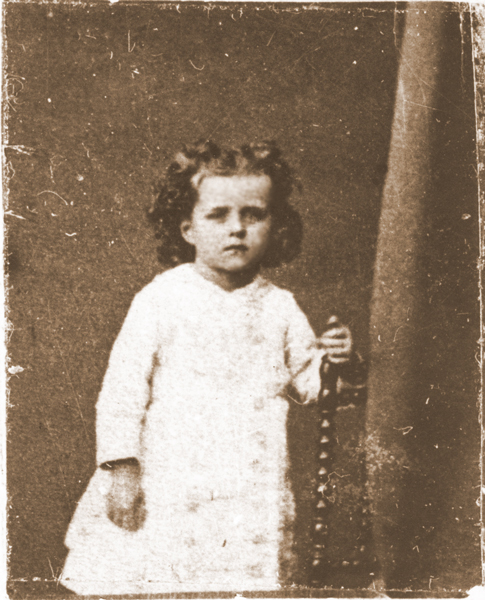
Therese at three and a half years old (July 1876)
---
One day, Léonie, thinking she was too big to be playing any longer with dolls, came to us with a basket filled with dresses and pretty pieces for making others; her doll was resting on top. “Here, my little sisters, _choose_; I’m [-15-] giving you all this.” Céline stretched out her hand and took a little ball of wool that pleased her. After a moment’s reflection, I stretched out mine saying: “I choose all!” and I took the basket without further ceremony. Those who witnessed the scene saw nothing wrong and even Céline herself didn’t dream of complaining (besides, she [-20-] had all sorts of toys, her godfather gave her lots of presents, and Louise found ways of getting her everything she desired).
This little incident of my childhood is a summary of my whole life; later on when perfection was set before me, I understood that to become _a saint_ one had to suffer much, seek out always the most perfect thing to do, and forget self ==I understood, too, there were many degrees of perfection and each soul [10v°] was free to respond to the advances of Our Lord, to do little or much for Him, in a word, to _choose_ among the sacrifices He was asking. Then, as in the days of my childhood, I cried out: “My God ‘_I choose all!_’ I don’t want to be a _saint by halves_, I’m not [-5-] afraid to suffer for You, I fear only one thing: to keep my _own will_; so take it, for ‘I _choose all_ that You will!”==
I must stop now. I must speak to you no longer about my infancy but of the little four-year-old rascal. I remember a dream I must have had around that age and it is still deeply imprinted on my imagination.’’ [-10-] I dreamed one night I went to take a walk all alone in the garden. When I reached the foot of the steps leading to the garden and which have to be climbed to get into it, I stopped, seized with fright. In front of me, near the arbor, there was a barrel of lime and on this barrel two _frightful little devils_ were dancing with surprising agility in spite of the flatirons they had on their feet. All of a sudden [-15-] they cast fiery glances at me and at the same moment appeared to be more frightened than I was, for they jumped from the barrel and went to hide in the laundry that was just opposite. Seeing they weren’t so brave, I wanted to know what they were going to do, and I went up to the window. The poor little devils were there, running on the tables, not knowing what to do [-20-] to hide from my gaze. Sometimes they approached the window, looking out to see if I was still there and seeing me there they began running like madmen.
This dream, I suppose, has nothing extraordinary about it, and still I believe God permitted me to remember it in order to prove to me that a soul in the state of grace has nothing to fear from demons who are cowards, capable of fleeing before the gaze of a little child!
[11r°] Here’s another passage I find in Mama’s letters. This poor little mother evidently had a presentiment that the end of her exile was near.
[[tcj-soas-ics-01-b#^tcj-fn-ch1-25|25]] “The little ones don’t disturb me since both of them are very good; they are very special, and certainly will turn out well. You and Marie will be able to raise them [-5-] perfectly. Céline never commits the smallest deliberate fault. The little one will be all right too, for she wouldn’t tell a lie for all the gold in the world and she has a spirit about her that I have not seen in any of _you_.
[[tcj-soas-ics-01-b#^tcj-fn-ch1-26|26]]
“The other day she was at the grocery store with Céline and Louise. She was talking about her practices. She was doing this rather loudly with Céline and the woman in the store said to Louise: [-10-] ‘What does she mean by these little practices? When she’s playing in the garden that’s all she talks about. Madame Gaucherin listens at the window trying to understand what this debate about practices means.’
“The little one is our whole happiness. She will be good; one can already see the germ of goodness in her. She speaks only about God and wouldn’t miss [-15-] her prayers for anything. I wish you could see her recite the little poems she learned. Never have I seen anything so cute. She gets the exact expression and tone all by herself. But it is especially when she says: ‘Little child with the golden hair, where do you believe God is?’ When she comes to the words: ‘He is up there in the blue heavens,’ she raises her eyes with an [-20-] angelic expression.
It’s so beautiful that one doesn’t grow tired of asking her to recite it, for there is something heavenly in her face!” [[tcj-soas-ics-01-b#^tcj-fn-ch1-27|27]] How happy I really was at that age, dear Mother! I had already begun to enjoy life; virtue had its charming qualities for me, and I was, it seems to me, in the same dispositions then as I am now, enjoying a firm [11v°] control over my actions.
Ah! how quickly those sunny years passed by, those years of my childhood, but what a sweet imprint they have left on my soul! I recall the days Papa used to bring us to the _pavilion_; [[tcj-soas-ics-01-b#^tcj-fn-ch1-28|28]] the smallest details [-5-] are impressed in my heart. I recall especially the Sunday walks when Mama used to accompany us. I still feel the profound and _poetic_ impressions that were born in my soul at the sight of fields enameled with _cornflowers_ and all types of wildflowers. ==Already I was in love with the _wide open spaces_.== Space and the [-10-] gigantic fir trees, the branches sweeping down to the ground, left in my heart an impression similar to the one I experience still today at the sight of nature.
We frequently met poor people on these long walks, and it was always little Thérèse who was put in charge of bringing them alms, which made her quite happy. [-15-] Very often Papa, finding the walk too long for his little queen, brought her back to the house before the others (which displeased her very much). And to console her, Céline filled her pretty little basket with daisies and gave them to her when she got back; but alas! grandmother [[tcj-soas-ics-01-b#^tcj-fn-ch1-29|29]] found her granddaughter had too many, so she took a large [-20-] part of them for her statue of the Blessed Virgin. This didn’t please little Thérèse, but she kept from saying anything, having got into the habit of not complaining ever, even when they took what belonged to her or when she was accused unjustly. She preferred to be silent and not excuse herself. There was no merit here but natural virtue. What a shame that this good inspiration has vanished!
[12r°] Oh! everything truly smiled upon me on this earth: I found flowers under each of my steps and my happy disposition contributed much to making life pleasant, but a new period was about to commence for my soul. I had to pass through the crucible of trial and to suffer from my childhood in order to [-5-] be offered earlier to Jesus. Just as the flowers of spring begin to grow under the snow and to expand in the first rays of the sun, so the little flower whose memories I am writing had to pass through the winter of trial.
---
## Footnotes
Chapter 1
1\. [[psalm-89#^psalm-89-2|Ps 89[88]:2]]\. The Vulgate Psalm numbers, common during Thérèse’s time, appear in brackets henceforth. ^tcj-fn-ch1-1
2\. The “Virgin of the Smile,” which is in the present shrine of St. Thérèse. The Martin family held it in special veneration. In January 1895 it was in the room outside her cell. ^tcj-fn-ch1-2
3\. [[psalm-23#^psalm-23-4|Ps 23[22]:1–4]]\. ^tcj-fn-ch1-3
4\. [[psalm-103#^psalm-103-8|Ps 103[102]:8]]\. ^tcj-fn-ch1-4
5\. In this figurative language Thérèse describes her family. When she was writing, there were “three lilies” with her in Carmel, viz., Marie, Pauline, and Céline; another, Léonie, was in the Visitation convent at Caen. Thérèse describes her two parents as “the two stems reunited for all eternity.” ^tcj-fn-ch1-5
6\. Letter of Madame Martin to Pauline, December 5, 1875\. [See p. ix above for explanation of manuscript reference numbers here.—Ed.] ^tcj-fn-ch1-6
7\. In a letter to Pauline, November 1875, Madame Martin wrote: “She will not climb the stairs all alone, but cries at each step: ‘Mama, Mama!’ If I forget to say: ‘Yes, my child,’ she stops and won’t go any further” (_Histoire d’une Ame_). ^tcj-fn-ch1-7
8\. Letter of Madame Martin to Pauline, October 29, 1876\. ^tcj-fn-ch1-8
9\. “Letter of Madame Martin to Pauline, May 21,1876\. _Histoire d’une Ame_ adds: “Coming on our dear little father’s name, I very naturally recall certain happy memories. When he came home I used to run and sit on one of his boots; then he would carry me in this way all around the house and out into the garden. Mama said laughingly to him that he carried out all my wishes; and he answered: ‘Well, what do you expect? She’s the queen!’ Then he would take me in his arms, lift me very high, set me on his shoulder, kiss and caress me in many ways. “I cannot say, however, that Papa spoiled me. I remember very well how one day when I was swinging contentedly, he passed by and called out to me: ‘Come and kiss me, my little queen!’ Contrary to my usual custom, I didn’t want to budge, and I answered boldly: ‘Come and get it, Papa!’ He paid no attention to me and was right to do so. Marie was there. She said: ‘You naughty little girl! How bad it is to answer one’s father in this way!’ Immediately I jumped off my swing for the correction was not lost on me! The whole house resounded with my cries of sorrow. I climbed the stairs quickly, and this time I didn’t call ‘Mama’ each step, for I thought of nothing but finding Papa and being reconciled to him. This was done very quickly. “I could not stand the thought of having offended my beloved parents. Acknowledging my faults was the work of an instant as this following incident recounted by my mother shows: ‘One morning, I wanted to kiss little Thérèse before going downstairs. She seemed to be in a deep sleep, and I didn’t dare awaken her; but Marie said to me: “Mama, she’s only pretending to be asleep; I’m sure of it!” Then I leaned over to kiss her forehead, but she immediately hid under her blanket and said with the tone of a spoiled child: “I don’t want anybody to see me!” I was very much displeased and let her feel it. Two minutes later I heard her crying and very soon, to my great surprise, I saw her at my side! She had left her bed all by herself and had come downstairs in her bare feet, hindered somewhat by her long nightdress. Her face was bathed in tears, and throwing herself at my knees, she said: “Mama, I was naughty; forgive me!” Pardon was quickly granted. I took my angel in my arms, pressed her to my heart, and covered her with kisses.’” (Letter of Madame Martin to Pauline, February 13, 1877\.) ^tcj-fn-ch1-9
10\.\ Marie, Thérèse’s oldest sister. ^tcj-fn-ch1-10
11\. She made her studies there. ^tcj-fn-ch1-11
12\. May 23, 1875, when Thérèse was only two and a half. ^tcj-fn-ch1-12
13\. Armindine Dagoreau. “I remember the poor little girl, Léonie’s companion, whom our mother dressed for her First Communion, following the custom of the better-off families. This child didn’t leave Léonie for one minute that day! In the evening she was given the place of honor at the banquet” (_Histoire d’une Ame_). ^tcj-fn-ch1-13
14\. Rose Taillé (1836–1908). She lived at Semallé, about eight miles from Alençon. Thérèse was entrusted to her from March 15 or 16, 1873, until April 2, 1874\. ^tcj-fn-ch1-14
15\. Letter to Pauline, May 14, 1876\. ^tcj-fn-ch1-15
16\. March 29, 1875\. ^tcj-fn-ch1-16
17\. Sister Marie-Dosithée (Marie-Louise Guérin), older sister of Madame Martin and a religious at the Visitation Convent at Le Mans. ^tcj-fn-ch1-17
18\. Letter of Madame Martin to Pauline, December 5, 1875\. ^tcj-fn-ch1-18
19\. Louise Marais (1849–1923), maid in the Martin family from 1865 until the death of Madame Martin. ^tcj-fn-ch1-19
20\. “It’s funny to see Thérèse put her hand in her pocket a hundred times a day to pull a bead of her chaplet every time she makes a sacrifice of some kind” (_Histoire d’une Ame_). ^tcj-fn-ch1-20
21\. Letter of Madame Martin to Pauline, November 8, 1876\. ^tcj-fn-ch1-21
22\. Letter of Madame Martin to Pauline, March 4, 1877\. ^tcj-fn-ch1-22
23\. “An expression my father used” (note of Mother Agnes). ^tcj-fn-ch1-23
24\. Letter of Madame Martin to Pauline, May 10, 1877\. ^tcj-fn-ch1-24
25\. Her sickness, cancerous in nature, appeared for the first time in 1865 in a mild form; it got worse in 1876\. ^tcj-fn-ch1-25
26\. Letter to Pauline, March 22, 1877\. ^tcj-fn-ch1-26
27\. Letter of March 4, 1877\. In the original French, the actual words of the poem are: “Petit enfant à tête blonde, où crois-tu [donc] qu’est le bon Dieu?” “Il est là-haut dans le Ciel bleu.” ^tcj-fn-ch1-27
28\. The Pavilion was a small piece of property acquired by Monsieur Martin before his marriage, on Rue des Lavoirs (today called Rue du Pavillon Sainte-Thérèse). ^tcj-fn-ch1-28
29\. Monsieur Martin’s mother, who frequently visited on Sunday. ^tcj-fn-ch1-29
---
**Source:** [[whimsical-bibliography#^wbiblio-tcj-soas-ics|Thérèse, *Story of a Soul*]]
> [[soas-chapter-2-les-buissonnets|Next →]]